
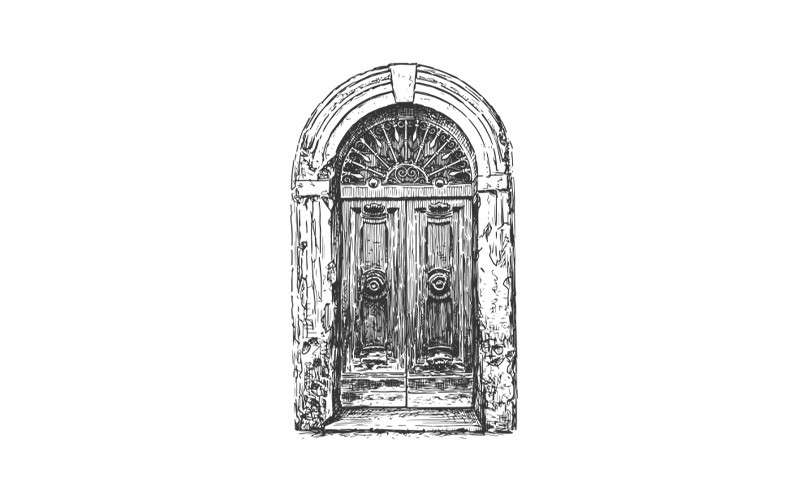
The Door
There were slaves to supervise, air to circulate in summer, and the heat from braziers to spread in winter. A door could have blocked the view, hindered the cooling effect of a breeze, or allowed the cold in when it was freezing outside. For these reasons, doors were a rarity in Greek and Roman homes. Made of wood and studded with bronze, they served mainly an aesthetic purpose and, since only noble families could afford them, when they were present, they served to obscure the interior of the masters' private rooms from the view of the servants. The Greeks and Romans installed doors mainly at the entrance to their homes to isolate them from the outside world and to prevent strangers and foreigners from entering. However, if that was the purpose, closing the door was no longer sufficient, and it became necessary to find a solution to prevent access from the outside.
The first locks appeared in Egypt, but it was the Romans who strengthened them with the use of metal and made progress in perfecting the mechanisms and developing a system to prevent break-ins. The size of keys was also reduced to a size that could be carried in a pocket or attached to necklaces worn around the neck or iron rings, which would give rise to the first key rings. But it was only with the invention of protruding parts, or ridges, that a key became the only object capable of fitting into the corresponding keyhole and activating the mechanism. Thus, only the owner could enter, and even in those days—between 30 BC and 529 AD—the home was perceived as a protected and safe place to live.
Having acquired a social role in the era and serving the needs of citizens, the door became an object of study and research, and the discovery of new techniques led to the design of the first automatic door. The physicist and mathematician Heron of Alexandria created a mechanism based on steam pressure produced by a hidden heat source that set in motion a system of pulleys and ropes capable of opening the large doors of temples. Single, double, triple, sliding, or folding: classical civilizations brought not only engineering innovations but also aesthetic ones, with new shapes and designs that the creativity of the time brought to the market. Monumental architecture could rely on heavier and more durable materials such as bronze to build the doors of the Pantheon in Rome, for example, or marble to cover the doors of funerary monuments. After all, according to the Roman architect Vitruvius, architecture is based on three principles—utility, stability, and charm—and doors at that time, and with those materials, seemed to respect them all.


