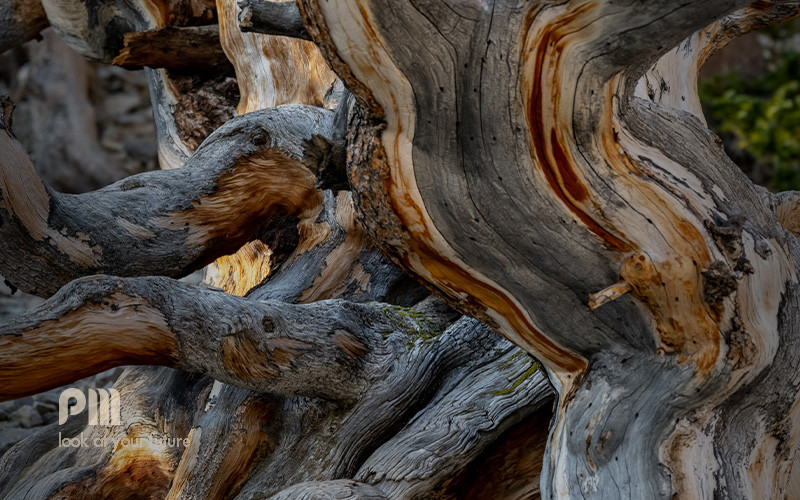
From the resilience of trees, praise for the slowness of life.
4862 rings.
It took him a week to count them in his laboratory with a powerful magnifying glass.
When he had it cut down in 1964 by the Nevada Forest Service, geologist Donald R. Currey did not know that, at 4000 meters on Wheeler Peak, he was looking at the oldest tree on the planet.
Formed from the same cells as when it was born, Pinus longaeva is a true example of resilience: it lives at high altitude, exposed to the cold and under snow for most of the year.
This is the secret of its longevity: its growth is slowed down by the extreme conditions of its natural habitat, with only two or three months available for photosynthesis and transforming the air into the wood of its trunk.
The discovery that over the last 20 years more than half of the forests in the southern hemisphere—where most of the world's trees are located—have become less resilient, while above the equator, towards the northern regions of the planet, the resistance of forests has become stronger and the adaptation of plants to the environment more lasting, confirms that it is the cold that prolongs the life of trees.
Slowing down the pace of life to prolong the cycle of life is the law of tree resilience: species that live at high speed die early.
Absorbing water and carbon dioxide at full speed and growing up to a meter per year causes trees to exhaust their potential after 40-50 years, exposing their wood to the harmful activity of insects and the aggressive action of fungi, the force of winds, and the power of storms.
But trees do not live longer just because of the cold, because researchers at the University of Arizona have found no signs of aging in the cells responsible for the growth of Pinus longaeva.
Led by Professor Julian Chen, in 2019 they studied the behavior of longevity enzymes, telomeres, and discovered the mechanism capable of slowing down the aging of trees: hopefully, it will also be useful for humans.
And so, at the age of almost 5,000 years, it can have the youthfulness of a 90-year-old and still possess the strength to carry the weight of several hundred kilograms articulated from its trunk in complex branches.
This resilience has been acquired over millions of years of slow evolution and, despite this, for the past century it has been threatened by the rapid progress of humans, which has had consequences for forests.