The value of sustainability in wood made from many types of wood.
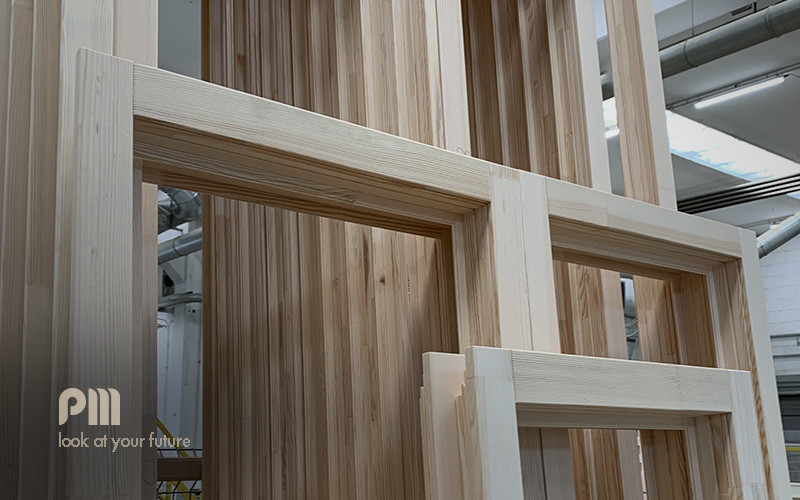
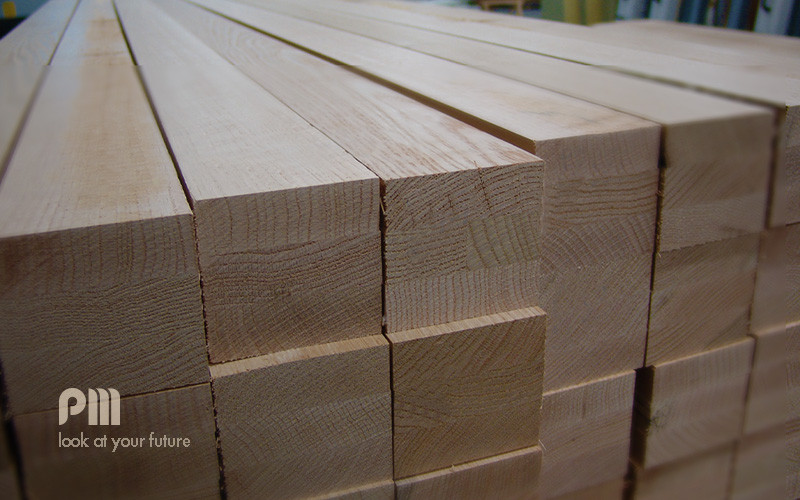
The quality comes first and foremost from the wood chosen: spruce, larch, oak, pine, beech, ash, and red grandis. The trunks are cut into strips of various widths and thicknesses. Each board then undergoes the third stage of the production process—drying—to achieve the moisture content on the surface of the wood required for the next stage: the application of glue. At least three lamellas are required to make laminated wood: cold-glued, one on top of the other, under pressure and with the grain facing in opposite directions to ensure greater uniformity in the strength of each lamella and overcome the dimensional and aesthetic limitations of solid wood.
Laminated wood can be made much longer and curved in ways that wood from a single tree trunk cannot. Its flexibility in taking on different shapes and sizes is highly valued by architects and designers, making it very popular in the construction industry. It flexes without breaking because it absorbs all the stresses of shock waves or undulating waves, thus contributing to the construction of buildings with high anti-seismic potential. The drying of the lamellas delays combustion in the event of fire: laminated wood burns much more slowly than solid wood and is therefore considered an insulating material in all respects because it is more resistant to fire than others. And then there is a very current advantage that makes it a sustainable material: energy savings. Laminated wood fixtures ensure low heat loss in the building where they are installed: they retain heat inside rooms in winter or maintain the coolness released by air conditioning in summer.
But in addition to thermal insulation, the multi-layer structure of laminated wood doors and windows also guarantees acoustic insulation in the interior spaces of the building, reducing noise from outside. Moreover, it is precisely these layers that ensure another advantage in terms of sustainability: performance over time. Laminated wood is non-deformable: it does not expand, crack, or split because the tension of the lamellas is canceled out by the compression of the layers. Compared to the warping that solid wood can undergo over time, laminated wood doors and windows have a long life ahead of them. The more irreplaceable they are, the more sustainable they are.