
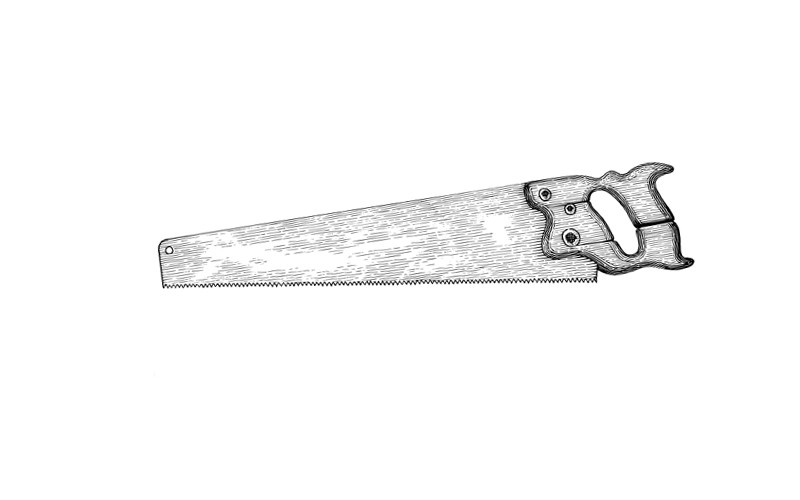
The Saw
It separates the wood along a precise incision line without wasting material, obtaining maximum yield from the very first cut. The blade penetrates the trunk and detaches it from its base and branches with an alternating movement that divides the fibers through an increasingly deep incision. Its action then continues with increasingly numerous divisions to obtain boards and planks, as well as smaller pieces that will make up the structure of the manufactured items.
With a cutting line perpendicular to the growth rings, the quality of the wood is higher because the surface of the boards will remain uniform, while the amount of waste will be high because the number of cuts is low. This waste is minimized with a cutting line tangent to the growth rings: this is the cut used for most of the wood on the market, but it produces a lower quality of boards due to their different appearance as the sawing moves away from the center of the trunk.
Before starting any type of cut, however, it is necessary to choose the blade's teeth. The greater the number of teeth, the smaller they will be and the more precise the cut will be, while a blade with fewer teeth, and therefore larger ones, will produce coarse cuts, but the work will be less tiring. This is why the Segone has two handles at the end of the blade, which are held by two people standing on either side of the log: to make the work less tiring. It takes all the energy of one arm to cut wood with the Saracco, the most widely used carpentry cutting tool, recognizable by its trapezoidal blade, while the one that most connects us to the traditional craft of carpentry is the blade of the frame saw, adjusted by the characteristic rope at the top.
Because what the saw separates, man recomposes: cut into several pieces by the toothed blade, the log will take on new forms thanks to the work of the carpenter who assembles the pieces and creates useful objects for the home and work.


